I Was Rejected for “Low Value Content” — Here’s Exactly What I Changed
A first-hand account: the real rejection screen I saw, the reason it wasn't what I assumed, the fixes I made, and my actual Search Console numbers since.
Most guides about the “low value content” rejection are written by people who want to sound like experts. This one isn’t. This is the site you’re reading right now, and it got that exact rejection. I want to show you the real screen, tell you what I wrongly assumed, walk through what I actually changed, and then show you my genuine Search Console numbers so you can judge for yourself whether any of it worked.
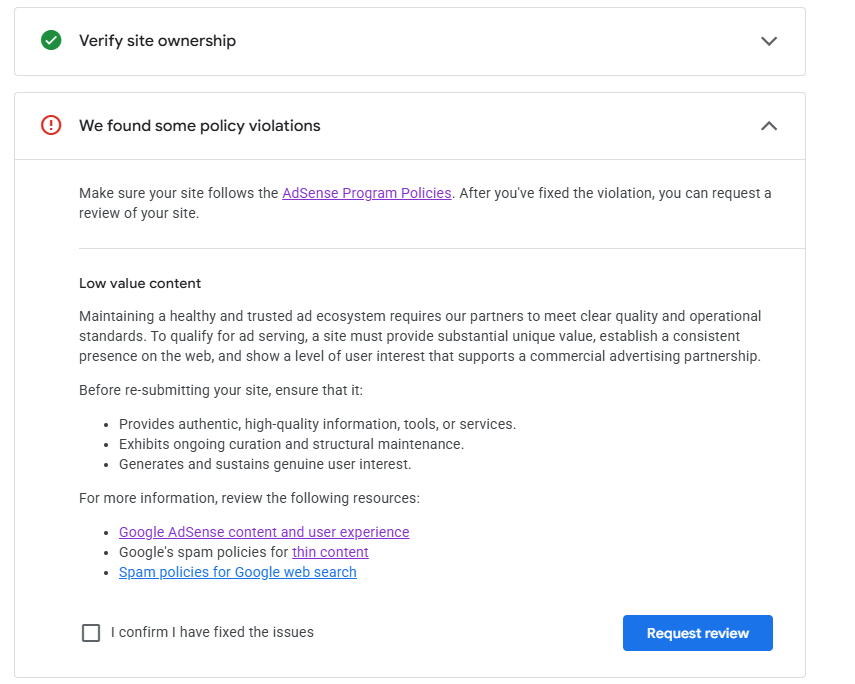
What the message does, and doesn’t, tell you
The hardest part of that screen is how little it says. “Low value content” is a single bucket Google drops a dozen different problems into: thin pages, duplicate text, a young domain, no real audience, missing policy pages, a site that reads as a tool rather than a publication. It never tells you which one applies to you. So my first instinct was the wrong one.
I assumed it meant my writing wasn’t good enough, so I rewrote articles. Nothing changed. I assumed I needed more pages, so I added more. Still rejected. I was treating a diagnosis I didn’t actually have, which is the single most common way to waste a month after this rejection.
The real reason wasn’t what I assumed
When I finally stopped guessing and audited the site coldly, two things stood out that had nothing to do with how well any single article was written.
First, the domain was under six months old when I applied. In several regions, including where I applied from, Google effectively will not approve a domain younger than about six months, and it reports that block as — you guessed it — “low value content.” No amount of rewriting fixes a calendar. Second, the site genuinely read as a utility with a thin blog bolted on, not as a publication someone maintains. There was no named author, no proper policy pages, and one embarrassing detail I’ll own: a homepage counter showing a made-up number of sites checked. Fake data on a site asking Google for trust. That had to go first.
What I actually changed
Once I knew the real problems, the fixes were concrete rather than cosmetic. In order of how much I think each mattered:
- I let the domain age. The least satisfying fix and the most important. I stopped resubmitting and gave it time to cross six months while I improved everything else.
- I removed the fabricated stat and made a rule: no invented numbers anywhere on the site, ever. If I can’t measure it honestly, it doesn’t get displayed.
- I put a real, named person on the site. A byline on every guide, an author page, a genuine About page. Accountability instead of an anonymous content wall.
- I added the trust pages I was missing — a proper privacy policy, plus cookie, editorial and content-review policies that describe how the site is actually run.
- I deepened the thin pages so each tool page explains the method, a worked example and its own limitations, rather than being a bare widget.
- I made the homepage lead with content, not just the tool, so a reviewer lands on something that reads like a publication.
None of that is glamorous. All of it was real, and all of it was pointing at the actual reasons rather than the reason I’d imagined.
Proof it’s working: my real Search Console numbers
Here is the part I can’t fake and wouldn’t want to. This is the site’s own Google Search Console performance while it earns real, organic traffic — not bought, not bots, just people finding the guides through search.
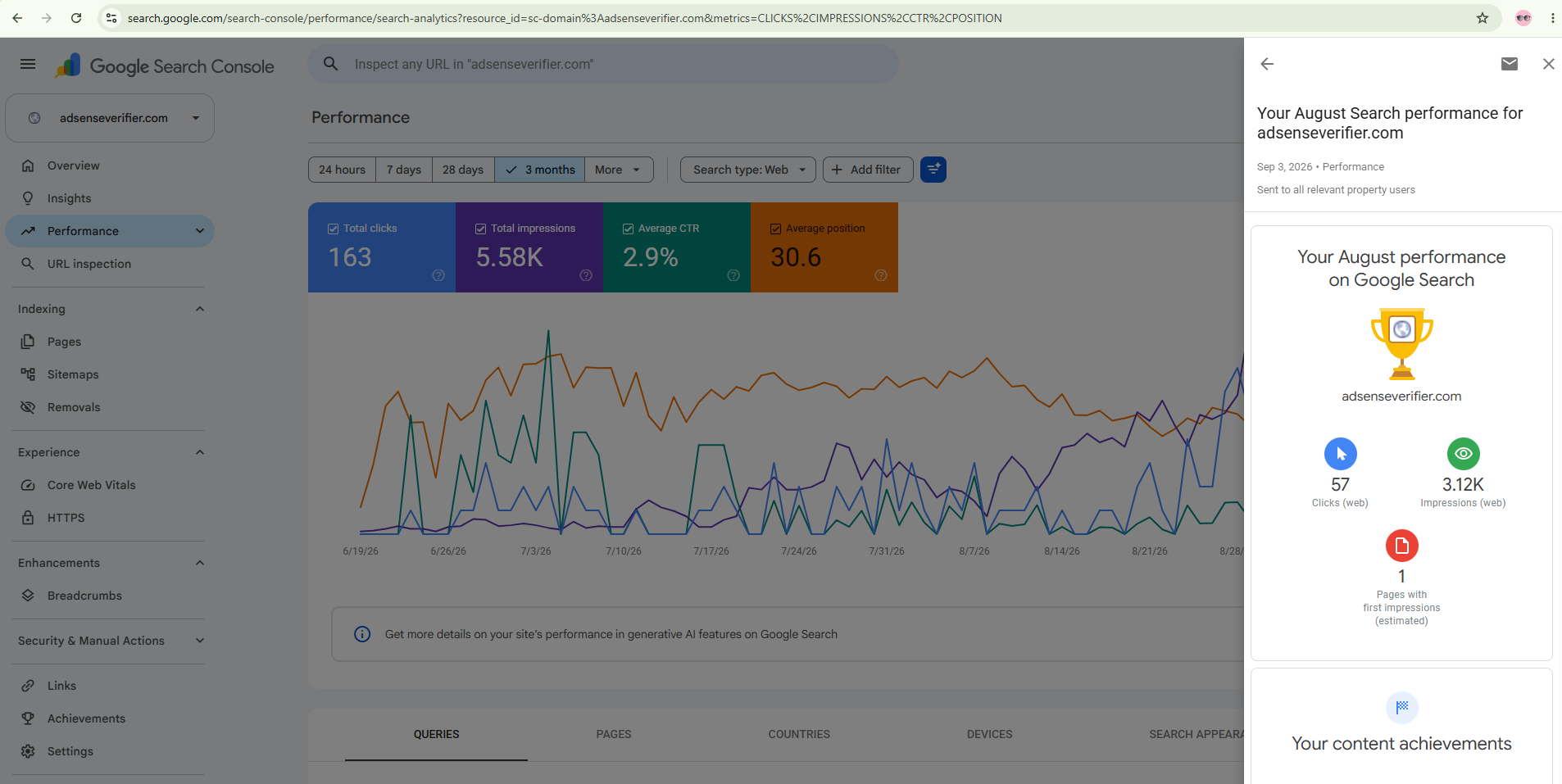
I’m sharing exact figures rather than a vague “traffic is growing” because that’s the difference between a real account and a marketing claim. If your own Search Console looks like this — small but rising, real impressions on real queries — you’re in a genuinely different position from a brand-new site with a flat line.
What I’d tell you if you just saw the same screen
If you landed here because you got the identical rejection, here is the honest version of what I wish someone had told me on day one:
- Don’t panic-reapply. Resubmitting the same site the same afternoon just burns a review cycle. Nothing changed, so the answer won’t either.
- Check your domain age first. If it’s under six months and you’re in a strict region, that alone can be the whole rejection. Wait it out; use the time well.
- Kill anything fake. Invented stats, placeholder text, “coming soon” blocks. A reviewer reads those as a site that isn’t ready.
- Become a publication, not a widget. Named author, real policy pages, content that leads. These are cheap to add and they change the whole first impression.
- Grow real traffic before you go back. Google’s own criteria ask for “genuine user interest.” Search Console numbers like mine are how you demonstrate it.
For the fuller version of that cycle, I wrote up the mechanics separately in reapplying after rejection and how to fix low value content. The domain age guide covers the six-month reality in detail.
Where this site is now
I’m writing this honestly, mid-journey. The domain has now passed six months, the fake data is long gone, there’s a real person behind every page, and the traffic above is genuinely climbing. When I reapply, it will be once, from that stronger position, rather than in a panic the same day. If you’re standing where I stood a few months ago, that’s the whole lesson: the rejection screen is vague on purpose, so stop guessing, find your actual reason, fix that, and give it real time. I’ll update this page with what happens next.
Run the audit on your own site
See, in fifteen seconds, which of the issues described here apply to your site — and which you’ve already cleared.
Run free auditMore guides
View all →Reapplying for AdSense After Rejection: A Recovery Plan
Rejected for low value content? A calm, concrete cycle: diagnose the reason, fix the substance, wait for the re-crawl, then resubmit once.
Images for AdSense: Copyright-Safe Sources (and Why Text-Only Posts Fail)
Why text-only posts read as thin, the copyright trap of Google Images, and where to get relevant, safe visuals with proper alt text.
How to Get Real Traffic Before You Apply for AdSense
AdSense has no traffic minimum, but real human visitors help. White-hat channels — search, Pinterest and social — without ever buying traffic.